How to Choose a Clothing Manufacturer in Turkey: Full Guide
Choosing a clothing manufacturer in Turkey means evaluating a factory against a specific set of criteria: production capacity, certification, production model, fabric sourcing, and transparency. Turkey has become one of the most reliable sourcing origins for fashion brands worldwide, home to tens of thousands of textile companies ranging from small cut and sew workshops to large vertically integrated factories. The difference between a manufacturer that delivers consistent quality on schedule and one that doesn’t rarely shows up in a first email exchange. This guide walks through every factor that actually matters, in the order most buyers need to evaluate them.
Why Turkey Is a Leading Destination for Apparel Sourcing
Turkey sits at the intersection of Europe, the Middle East, and Central Asia, which means shorter shipping times and lower freight costs than sourcing from East Asia. A shipment from Turkey to Central Europe typically takes three to four days by road, compared to three to four weeks by sea from China or Bangladesh. For brands running frequent reorders or reacting to in-season demand, this nearshoring advantage alone can outweigh a lower per-unit price elsewhere.
The country’s textile industry also carries decades of accumulated technical expertise, particularly in woven fabrics, knitwear, and denim. The EU-Turkey Customs Union removes import duties on most apparel categories for European buyers, a cost advantage that is easy to underweight in an initial price comparison but compounds significantly at volume. Combined with a mature network of fabric mills, trim suppliers, and finishing plants, this makes Turkey one of the few sourcing regions where a brand can run a fully vertically integrated production chain, from yarn to finished garment, without crossing a border.
Looking for a Clothing Manufacturer in Turkey?
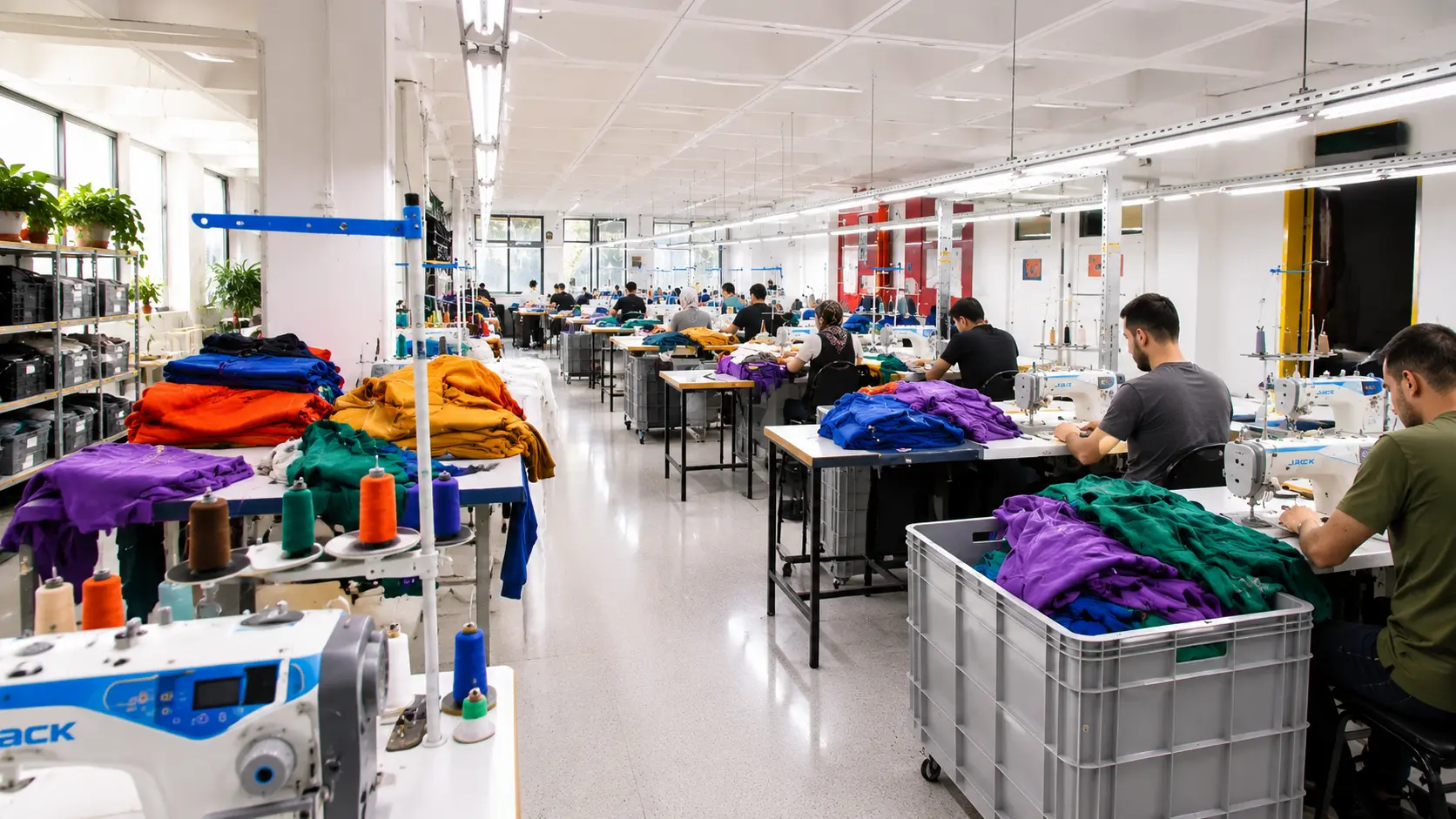
KB Fashion and Textile has been manufacturing apparel in Izmir since 1997, with a production capacity of 30,000 units per month across women’s, men’s, children’s, workwear, streetwear, and loungewear categories. The facility holds GOTS and OCS 100 certification, uses OEKO-TEX certified fabrics, and supports private label, OEM, ODM, and custom production from a single integrated line.
Istanbul, Izmir, or Bursa: Does Location Matter?
Within Turkey, apparel manufacturing concentrates around a handful of cities, and each has a different specialty. Istanbul is known for high-end fashion, smaller batch runs, and fast turnaround on trend-driven collections, supported by a dense cluster of sample rooms and fabric wholesalers. Izmir has built its reputation on vertically integrated knitwear production, with direct port access that shortens export lead times, since fabric sourcing, cutting, sewing, and finishing often happen under one coordinated roof rather than through scattered subcontractors. Bursa and Denizli, further inland, are historically strong in denim and woven home textiles respectively.
Neither city is objectively better. The right choice depends on what you’re producing: a brand doing frequent, small, fast-turnaround drops may lean toward Istanbul’s agility, while a brand scaling knitwear, streetwear, or loungewear in consistent volumes often benefits from an integrated factory with direct port logistics.
Production Capacity and MOQ: What to Ask For
Two different questions get confused here, and it’s worth separating them. Production capacity is how much a factory can physically produce in a given period, which tells you whether a manufacturer can handle your target volume as you scale. Minimum order quantity (MOQ) is the smallest order a factory will accept per style, which tells you whether you can even get started as a startup clothing brand or boutique label.
Across Turkish manufacturers, MOQ commonly ranges from 50 to 500 units per style, depending on fabric type, print or embroidery complexity, and whether multiple colorways share the same base fabric. A few patterns are worth knowing before you request quotes:
- Combining several styles within one fabric and weight typically lowers the MOQ you’re quoted, compared to a single style in an unusual fabric. This is why low MOQ clothing manufacturers often push buyers toward a shared fabric base across a small collection rather than one-off pieces.
- Manufacturers offering full package production (fabric sourcing through finished garment, sometimes called FOB production) tend to set MOQ per fabric roll, not per design, since fabric minimums drive the constraint. A CMT (cut, make, trim) arrangement, where the buyer supplies the fabric, can sometimes work with smaller volumes since the fabric minimum is removed from the equation.
- A manufacturer that refuses to state any MOQ range before seeing your tech pack isn’t necessarily hiding something, but one that won’t discuss MOQ logic at all is worth questioning.
On the capacity side, ask for a concrete monthly production figure rather than a vague assurance, and confirm whether that figure includes sampling and pattern development time or only bulk production.
Certifications That Actually Matter (and How to Verify Them)
Certifications are frequently listed on manufacturer websites, but not all of them mean the same thing, and few buyers check whether a claimed certification is actually current or issued by a recognized body.
GOTS (Global Organic Textile Standard), administered by Global Standard gGmbH, is the most rigorous certification for organic textiles. It covers the organic origin of raw materials and the entire processing chain, including dyeing, finishing, and labor conditions at the production facility.
OCS 100 (Organic Content Standard), governed by Textile Exchange, verifies that a product is made entirely from organically grown material. It focuses specifically on material traceability rather than the full processing chain that GOTS covers.
OEKO-TEX (STANDARD 100 by OEKO-TEX), issued by the OEKO-TEX Association through its member testing institutes, confirms that a textile has been tested for hundreds of substances that could be harmful to human health. This is a fabric-level guarantee worth asking every manufacturer to clarify, since some factories claim OEKO-TEX certification broadly when only specific fabric lines actually carry it.
Before taking a certification claim at face value, ask the manufacturer for their current certificate number and check it against the certifying body’s public database. A manufacturer confident in its certifications will provide this without hesitation, the same way a legitimate factory will not hesitate to schedule a facility audit.
Private Label, OEM, ODM, or Custom: Choosing the Right Production Model
These four terms get used loosely across manufacturer websites, but they describe genuinely different working relationships, and picking the wrong one for your situation slows everything down.
Private label manufacturing is the right fit when you already have a defined collection and branding, and simply need a factory to produce and package it under your name. The manufacturer handles pattern grading, cutting, sewing, and quality control against your specification, while labeling, hang tags, and packaging are produced to your exact brand identity. This differs from white label production, where a factory sells a pre-made, unbranded product that multiple buyers can label as their own.
OEM (original equipment manufacturing) suits brands with a complete technical package, meaning patterns, measurements, and construction details, who want the manufacturer to execute exactly to that specification without additional design input.
ODM (original design manufacturing) is the better fit when you don’t have an in-house technical team. The manufacturer’s own design team develops the pattern and construction from a brief, mood board, or reference images, which shortens the path from concept to sample for brands entering a new category.
Custom manufacturing is the umbrella term for made-to-order production shaped around requirements outside a standard catalog offering, such as non-standard fabric weight, custom pattern making, unique construction, or specific size grading needs.
Most buyers use a blend in practice: an OEM relationship for their core, established collection, with occasional ODM support when entering a category they haven’t designed for before, and a fully custom arrangement for one-off or highly technical pieces.
Understanding Fabric Sourcing and Options
The fabric range a manufacturer actually works with, not just the sustainable materials featured on their homepage, tells you a lot about their real capabilities. A well-equipped Turkish manufacturer typically offers a mix of conventional and sustainable options: cotton and cotton blends (cotton-elastane, cotton-polyester, cotton-viscose), polyester and its blends, viscose, polyamide, modal, bamboo, Tencel, satin, and silk, alongside sustainable options like organic cotton, linen, EcoVero viscose, RWS-certified wool, and recycled polyester.
Fabric weight, measured in GSM (grams per square meter), matters as much as fiber type for garments like hoodies, sweatshirts, and outerwear. A manufacturer that only lists three or four “eco-friendly” fabrics on a marketing page but can’t discuss GSM ranges, blend ratios, or conventional fabric options in detail may have a narrower actual production capability than their website suggests. Ask for a full fabric library, not just the sustainability highlights, and confirm whether fabric is sourced externally or knitted or woven in-house, since a vertically integrated knitting mill generally means shorter lead times.
The Production Process: What Happens After You Send a Tech Pack
Understanding how an order actually moves through a factory helps you judge whether a manufacturer’s timeline claims are realistic. A properly integrated production line typically follows six stages: design (developing collections, models, and technical drawings from your ideas or existing references), pattern development (pattern making, grading, and CAD-based sizing), sampling (a pre-production prototype produced and approved before bulk production begins), fabric and trim sourcing (fabrics, accessories, labels, and trims sourced or manufactured to your specification), bulk production and quality control (planned mass production with inspection both before and during manufacturing), and delivery (final quality checks followed by dispatch through a reliable logistics network).
A manufacturer that skips steps in this process, particularly pre-production sampling or in-process quality checks, is taking on risk that eventually lands on your side of the relationship. Ask specifically how many sample rounds are typically needed before an order moves to bulk production, since this single detail often predicts how smooth the rest of the relationship will be.
Red Flags: How to Spot an Unreliable Manufacturer
A few warning signs show up consistently among manufacturers that underdeliver:
- Reluctance to allow a factory visit. A legitimate manufacturer welcomes visits from existing or prospective clients, whether in person or through a live video walkthrough. Evasiveness about the actual production floor is one of the clearest signals to walk away.
- No references from previous clients. Ask for references and check them. A manufacturer with a genuine track record will have brands willing to vouch for them; one that avoids the question either lacks the experience or the relationships to back it up.
- Pricing significantly below market average. Unrealistically low quotes usually mean cut corners somewhere: substandard fabric, uncompensated overtime, or skipped quality control stages.
- No willingness to sign an NDA. Before sharing a tech pack or original design, a non-disclosure agreement is standard practice. A manufacturer that resists signing one is not treating your intellectual property seriously.
- Certifications that can’t be verified. If a certificate number isn’t provided or doesn’t match the certifying body’s database, treat the certification claim as unconfirmed.
- No clear answer on production model. If a manufacturer can’t clearly explain whether they work OEM, ODM, private label, or CMT, they may not have a structured production process at all.
A Practical Checklist Before You Commit
- Confirm both production capacity and MOQ, and understand how MOQ is calculated (per style vs. per fabric)
- Request current certificate numbers and verify them independently against the certifying body’s database
- Clarify which production model (private label, OEM, ODM, custom, or CMT) fits your project
- Ask about sampling lead time and how many rounds are typically needed
- Request references from at least two previous clients
- Request to visit the factory, virtually or in person, before placing a first order
- Confirm export markets the manufacturer already ships to regularly
- Ask whether fabric is produced in-house or sourced externally, and what that means for lead time